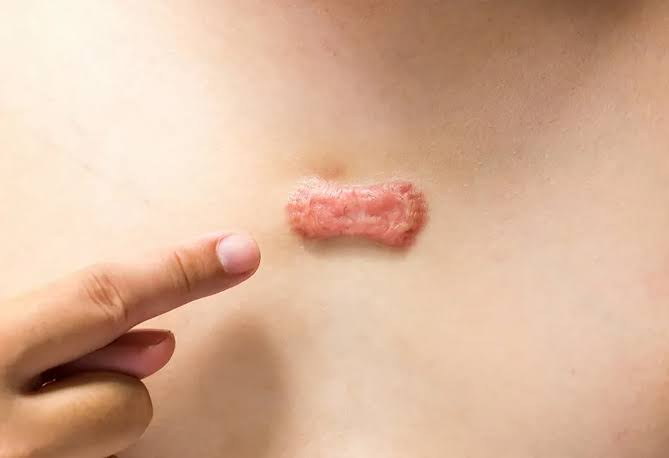
A keloid isn’t just an “unsightly scar.” It’s a living mass of tissue with its own blood supply, one that tends to keep growing if left untreated. The better you understand what it actually is, the easier it becomes to choose the right treatment — instead of chasing methods that only deal with the surface.
What is a keloid?
A keloid is the result of a wound-healing process that got “misprogrammed”: instead of stopping once the wound has closed, the body’s healing system keeps working overtime, continuously producing collagen with no stopping point. This excess tissue builds up into a dense, fibrotic mass that rises noticeably above the surrounding skin.
Unlike an ordinary scar — which is essentially “dead” scar tissue that no longer grows — a keloid is fed by its own network of micro-blood vessels. It exists and grows like an independent living tissue. This is why a keloid can be compared to a weed on the skin: cut the top off, and it grows right back, because the root is still there underground.
Why ordinary methods struggle to treat it
Because its root — the fibrotic base of the scar and the blood vessels feeding it — sits deep beneath the epidermis, while creams, skin peels, and other surface-level scar treatments only reach the outermost layers of skin. Without reaching that root, the keloid keeps being fed and tends to return to exactly how it was as soon as you stop treatment.
This is why many people apply scar cream diligently for a year with almost no change — the issue was never a lack of consistency, but that the method never reached the place it needed to reach.
Who should consider keloid treatment?
You may want to consider treatment if you fall into one of these situations:
- A newly formed keloid after acne, a wound, surgery, or piercing that’s still actively developing
- A long-standing keloid that hasn’t improved despite creams, injections, or skin peels
- A scar that itches, feels uncomfortable, or affects your confidence when wearing clothing that exposes that area
- A scar that keeps spreading or darkening over time
When should you start treatment?
As a general rule, the earlier you intervene — while the keloid is newly formed and still soft — the more straightforward the process tends to be compared with a long-standing, fully fibrotic scar. That said, older keloids can still be treated, since the technology works directly on the fibrotic structure and blood supply regardless of how long the scar has existed. The specific response depends on an in-person assessment by your doctor.
Where to treat a keloid, and with what method
At Kanghee Dermatology Clinic, keloids are treated with a 3-layer technology that targets the “root” surface methods miss entirely:
Layer 1 — Breaking down the fibrotic base Fractional thermal energy, precisely calibrated to tissue depth, is directed straight at the base of the scar. The abnormal collagen bundles are selectively broken down while surrounding healthy tissue is left untouched. The foundation holding the scar mass in place begins to weaken.
Layer 2 — Cutting off the nutrient supply The specialized micro-blood vessels feeding the scar are subjected to controlled, localized ischemia. Once cut off from its nutrient supply, the mass can no longer sustain its size — it gradually shrinks, softens, and flattens from the inside out.
Layer 3 — Regenerating skin tissue with Exosomes Fibroblast Exosome extract is delivered directly into the freshly treated tissue base, right when the skin is at its most receptive. The Exosomes activate healthy fibroblasts to produce new collagen and elastin with normal physiological structure, fully replacing the old fibrotic tissue — while also eliminating the itching and irritation caused by chronic inflammation within the scar.
What does the treatment process look like?
- Consultation & classification — Your doctor assesses the scar’s depth, degree of fibrosis, and likely response to treatment.
- Treating the fibrotic structure — The scar’s base and its blood supply are addressed simultaneously, causing the mass to break down, shrink, and flatten.
- Tissue regeneration with Exosomes — Activates healthy collagen and elastin production, restores microcirculation, and eliminates itching and irritation.
- Aftercare — Stage-by-stage at-home care guidance, with periodic follow-up visits to optimize results.
Expected outcome: the scarred area becomes level with the surrounding skin, skin tone recovers to close to 95% match with normal skin, and the texture becomes smooth, firm, and naturally elastic. For mild cases, the scar is nearly undetectable after treatment.
Book Your Free Exoscar Consultation
One-on-one consultation · Personalised treatment plan
👉 Book My Free Consultation